
Delaware County Most Wanted: What Exists
Start with the Delaware County Sheriff Bench Warrant Division. It executes bench warrants handed down by the Court of Common Pleas. Its published material stresses rights, dignity, and safety. So it is an enforcement office, not a photo gallery. The county pages offer no most wanted list at all. There is no roster of active names, no posting schedule, and no stated policy on photographs.
That absence is worth sitting with. A most-wanted notice serves as a selective safety publication. A warrant check, by contrast, asks an authorized office to verify one person's status. Missing a list does not mean warrants vanish from Delaware County. Wanted investigations have not stopped either. It simply means nothing public can be copied, counted, or called complete. A viral headline, an old social post, or a search snippet cannot stand in for live confirmation.
The official Bench Warrant Division page is the county's designated contact point. Think of it as an agency safety resource. It is not a wanted-person collection.
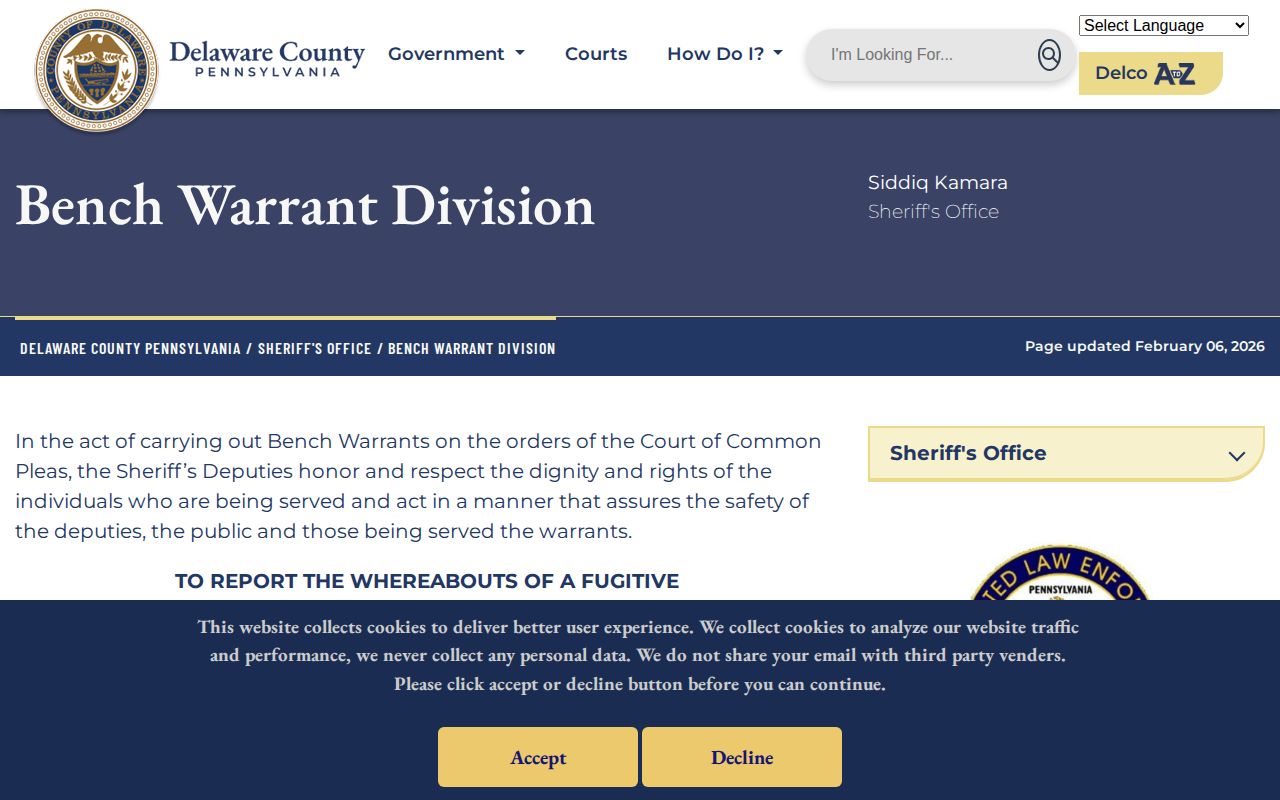
That contact path explains the right move. A question about a specific warrant belongs with the Sheriff, the court, or a lawyer. It does not belong with any copied listing.
No photographs appear here. If the Sheriff publishes a notice down the road, that would be the right home for an agency-selected image and its safety instructions. The case record kept by the court tells the story of what happened. A notice or a picture does not.
Delaware County Wanted Listing Fields
No verified Delaware County listing fields exist to describe. There is no official public list. Treat the table below as a checklist for vetting any future Sheriff publication, not a picture of a current roster. It refuses to guess at identities, photographs, conduct, or status. Before trusting a page someone claims is current, confirm the Sheriff actually hosts it. Look for a clear update indicator on the page itself.
| Field to verify | Why it matters |
|---|---|
| Last-updated date and entry count | Shows when the agency last reviewed the notice and how many entries it says it contains. |
| Name and alias | Helps distinguish people with similar names without treating a partial match as identification. |
| Alleged warrant basis and court | Identifies the stated reason for the notice and whether the matter is connected to the proper court. |
| Agency and tip instructions | Shows which office issued the notice and where information should be sent safely. |
| Photograph and disclaimer | Must remain on the issuing agency’s page, with its date and warning language intact. |
Even if a list appears someday, it can be incomplete or lagging by design. It should never stand in for a direct check with the court or the Bench Warrant Unit. A name in a news story or incident log proves nothing about an active warrant. Use any future public list the way it was built to be used: a safety notice, not a lookup tool for a particular person.
- Confirm the page is on the official Delaware County Sheriff domain and note its last-updated date.
- Read the stated alleged basis, issuing agency, disclaimer, and the official tip instructions in full.
- Send information through the listed official contact if it is relevant, but never approach or photograph the person.
- Use the court, attorney, or Bench Warrant Unit for a specific status question instead of treating the list as complete.
Note: A public notice reflects an agency's concern and never replaces the case record kept by the court.
Use Delaware County Warrant Contacts
No Delaware County portal lets you type a name and pull a real-time warrant result. Anyone facing a possible warrant should work through the court, the Sheriff's Bench Warrant Division, or an attorney. The Sheriff directory lists the Bench Warrant Unit at 610-891-8605. A phone call will not turn casual curiosity into a public result. It does steer an affected person toward real verification and resolution.
Keep the sequence below aimed at official confirmation and a safe outcome. It is not a route for dodging service, hiding a location, or predicting enforcement. Any immediate danger calls for emergency services, not a webpage.
- Write down the full name and any known court or docket details so the correct Delaware County matter can be identified.
- Contact an attorney, the relevant court, or the Bench Warrant Unit for the proper status and resolution route.
- Use PA UJS Case Search only to locate public docket activity, then compare it with information from the responsible office.
- For a separate current-custody or booking-record question, use the county-wide Delaware County custody and records path, which distinguishes VINELink, Central Records, and court records.
A court docket can trail behind events. Some records never show up at all. Juvenile, sealed, expunged, and limited-access matters stay out of the ordinary UJS public search. A docket entry has another blind spot too. It won't say whether the Sheriff has executed a warrant in real time. Treat it as a court-history tool, not a warrant database.
Delaware County Warrant Types and Timing
A warrant label names a process. That's all it means. Delaware County's criminal-justice materials describe several paths into central intake: probable cause, an arrest warrant or bench warrant, an alleged probation or parole violation, or contempt. Each path can land in a different court. Custody decisions and release outcomes differ too. Knowing these distinctions keeps an old report from being mistaken for a current status.
| Term | Local context |
|---|---|
| Bench warrant | A court-issued warrant. The Sheriff’s Bench Warrant Division executes Court of Common Pleas bench warrants. |
| Arrest warrant | A warrant connected to an arrest process. Public court activity may exist, but UJS is not a complete current-warrant source. |
| Contempt matter | The county prison describes bench-warrant or contempt hearings as ordinarily addressed within 72 hours after central intake. |
| Detainer or hold | A custody restriction that can affect release. It is not the same thing as proof of a public wanted notice. |
The Delaware County Criminal Justice System materials lay out the local clock. Arraignment happens within 72 hours of arrest. A preliminary hearing generally falls three to ten days out. Formal arraignment, trial, sentencing, or appeal follow from there. These are process markers, not promises about any single case. After a hearing, a judge may grant bail, deny it, or attach conditions. The public court record does not always update in step with custody information.
Submit Delaware County Warrant Tips Safely
The Sheriff's Bench Warrant Division runs its own confidential tip line. An electronic tip route exists too. Those are the official channels. Callers should stick to what they actually know, since deputies are the ones trained to weigh it. No reward program or Crime Stoppers arrangement comes through the Division. The confidential tip line is the whole package. Once the information is in the Sheriff's hands, let law enforcement decide what comes next.
Someone in immediate danger? Call 911. That rule comes first, before any tip line. Never approach, follow, or confront a person on a warrant, and never try to detain anyone yourself. A wanted notice can be stale, incomplete, or aimed at a different person with a similar name. The public's safest role is simple: pass along what you saw through the Sheriff's channel and let trained officers handle the rest.
Delaware County Warrant Alerts and Apps
Don't count on an app here. The Delaware County Sheriff does not publish a wanted list, booking roster, or booking photographs through a mobile app. No routine social-media feature fills that gap. A reposted image may look official. It still proves nothing about a warrant's current status.
Pennsylvania's SAVIN notification service, reached through VINELink, serves a different purpose entirely. It sends release, escape, and movement notices by phone, text, email, or app for participating systems. It won't hand you a county warrant list or a stream of booking photos. Custody questions go to that notification channel. Warrant questions go to the court, counsel, or the Bench Warrant Division.
Why UJS Cannot Confirm Delaware County Warrants
PA UJS covers the court side of things. Its public search accepts a participant name, date of birth, county, judicial district, docket type, status, citation, docket number, or arresting agency. Case numbers help too. Common Pleas dockets begin with CP. Magisterial district judge cases begin with MJ. Those filters work well for finding a docket after an arrest. They cannot show every active warrant or whether one has been served.
A UJS docket lets the public follow an arraignment, preliminary hearing, filed charges, plea, disposition, sentence, and appeal. Recent entries sometimes lag behind. Juvenile matters and many sealed, expunged, or limited-access records stay out of ordinary public results. A missing docket proves nothing either way about a warrant. For an actual status answer, the court and the Sheriff are the right doors to knock on.
Delaware County Custody and Court Follow-up
Warrant status, current custody, and final case outcome are three separate questions. For someone believed to be in county custody, the prison's "looking for inmate" route points to VINELink. That is Pennsylvania's custody-notification channel. It can report a custody event for participating systems. It is not a photo service, though, and not a complete recent-bookings archive. Results shift with transfers and releases, and a blank search doesn't mean no arrest happened.
Proof-of-incarceration and resident-record questions belong to Central Records at George W. Hill Correctional Facility. The main number is 610-361-3200 ext. 300. Records and Booking sit at extensions 316 and 317. Those offices play a different role than the Sheriff's warrant unit. Custody records matter once a warrant has been served, while PA UJS tracks the court's disposition of the case.
Never lean on one source alone. A custody notification shows an event. A booking record describes intake. A docket shows later court action. Each needs its date, the right person, and the originating office confirmed before anyone relies on it.